
What Challenges Do Small Businesses Face When It Comes To Marketing?
Learnings from a Central Otago Small Business Marketing Survey
SUMMARY
December 2025
Running a small business in Central Otago, especially in the lakes district, comes with a unique mix of opportunity and challenges: it’s seasonal, growing and stretched in places, and small enough that local reputation is very important.
With over 10,600 business units across Queenstown, Wānaka, Cromwell, and Alexandra, our region is full of creative, hard-working people building businesses in one of the most competitive and seasonal markets in New Zealand. And yet, like the national picture where 97% of all NZ businesses have fewer than 20 employees, local businesses often face the same pressure points:
- limited time,
- limited budget,
- constantly shifting customer behaviour.
The purpose of this survey was to understand how small service-based businesses in our region are really approaching their marketing, what's working, what isn't, and where support is most needed.
I hope that this information will help you make more cost-effective decisions for your business when it comes to your marketing strategy in 2026.
I have compared the results from our 30 respondents with national data from MBIE, Business.govt.nz, Infometrics, and QLDC economic research, and they show a clear picture:
- Many businesses are doing incredible work.
- Referrals are strong,
- Reputation really matters
Most owners indicated they want to be known for quality, trust, reliability, and professional service.
Nationally, many digital marketing tools are underutilised: only 56% have a website, only 17% use any form of digital advertising, and fewer than half track basic performance metrics. The Survey shows a similar trend when it comes to the use of advertising platforms and tracking the efficacy of these.
Most businesses want more leads. Most feel short on time, short on money, and unsure which marketing channels actually work. Digital marketing feels overwhelming.
In our region, business owners also have to navigate the following challenges:
- Tourism, construction, and property are the dominating industries,
- Demand fluctuates significantly,
- Competition is increasing and
- we have one of the fastest population growth in NZ *
Visibility actually becomes even more important.
This report highlights what local businesses are already doing well, where the biggest gaps are, and what opportunities stand out for the year ahead. It also connects these findings back to broader national and regional trends, including the sharp shift toward digital advertising across New Zealand and the growing push from QLDC to diversify the local economy and build a more resilient business ecosystem.
* Population growth in QLDC is among New Zealand’s fastest: 8% (3,900 people) in the year to June 2023, largely driven by migration, which supports local demand for services but strains housing and infrastructure
1. Small businesses and their challenges
Central Otago and the Queenstown Lakes district are overwhelmingly small-business economies, reflecting national trends where 97% of NZ businesses have fewer than 20 employees.(business.govt.nz)
However, survival rates drop sharply over time, only 55% survive 5 years, and sole-operator survival after 10 years falls to 25% (business.govt.nz). We were very lucky to have a couple of these “surviving sole trade heros” sharing their knowledge and expertise in this survey.
This context helps explain why most respondents cited marketing uncertainty, lack of time, and limited budgets as major obstacles.
2. The regional business landscape:
The region hosts around 10,653 businesses (business units) as of March 2025 (Infometrics.co.nz). Tourism, construction, and property dominate the local economy, with accommodation/food services making up 14.1% of GDP and tourism contributing ~24%, Construction (10.6%) and real estate (10.5%).
These industries face, workforce shortages, housing constraints and seasonality pressures, confirmed in the QLDC 2019 Remote Economy Report
As QLDC is aware of these issues, it has published a region’s diversification plan that aims to reduce tourism-reliance and support new high-value sectors and businesses.
These conditions influence how and when businesses market themselves, and you as the business owner can see the flow-on-effect in your “slow months” and how you respond to these findings.
Industries that participated in the survey:
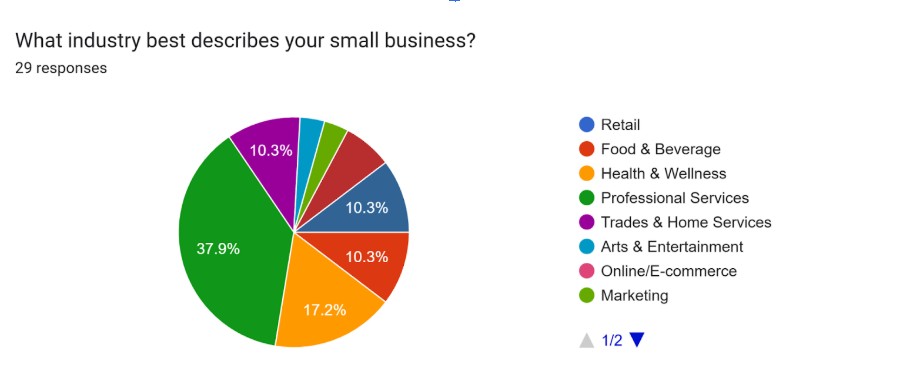
dark red: tourism
dark blue: other.
With that said, the next question is: how are local businesses actually showing up online?
3. Growth opportunities
Despite population growth and strong competition in New Zealand, nationally only ~56% of NZ small businesses have a website, and just ~17% use digital or social media advertising (MBIE). Use of CRM systems, booking tools, and content-creation technology sits at ~15% (employmenthero.com + MBIE).
The Central Otago survey mirrors this gap:
Many feel overwhelmed by social media
Almost half do not track marketing metrics (48.4%)
Inconsistent or low posting frequency
Tip -> There is a major opportunity here for improved digital systems, automation, and performance tracking. Examples are automated emails, text messaging, seeing where your leads come from, Ai answering booking systems (so you don’t have to stop what you are doing - as a customer I have found this experience so quick and easy when booking a table at a Dunedin brewery last month!).
4. Word-of-Mouth dominates but it’s not enough in a seasonal economy
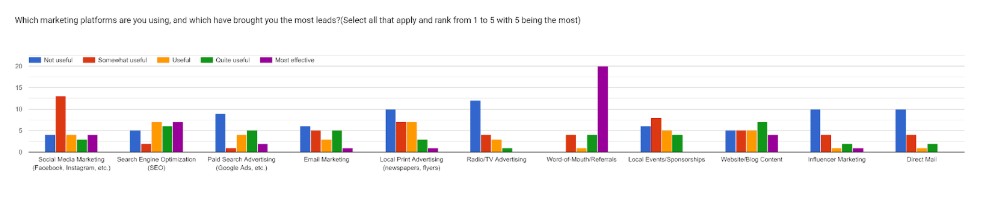
The Survey indicated that word-of-mouth is by far the top lead source (93%) and the most reliable marketing tool across respondents. And yet ~42% would like more leads.
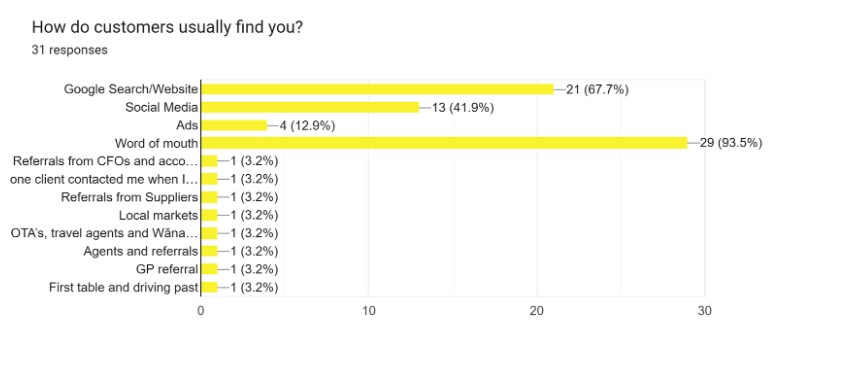
Relying on referrals alone is risky in a region affected by:
Seasonal tourism
Inconsistent demand
Population turnover
Changes in industries and workforce
Businesses who want year-round stability must diversify into reviews, active referral campaigns, SEO, and digital visibility, which all ranked highly in the survey as being effective.
Tip -> Reviews can be improved with email automation, a referral campaign and digital visibility.
5. Dominant branding themes:
Across industries, businesses want to be known for:
Quality & reliability
Trust & confidence
Good customer experience and service
Specialised expertise
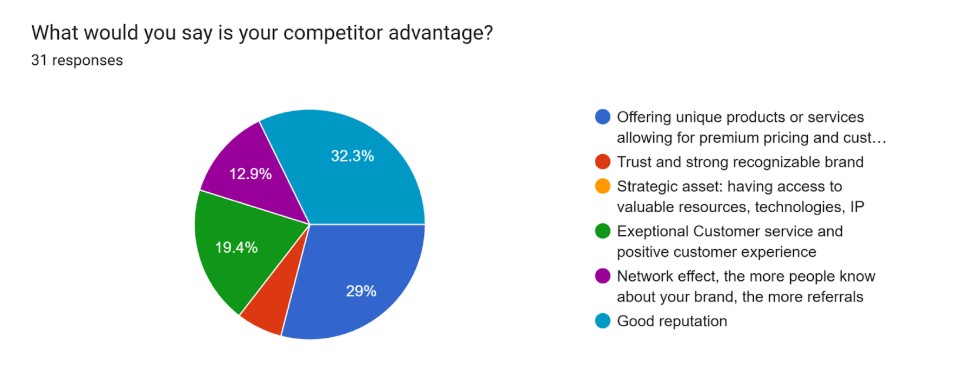
This aligns with national small-business positioning trends, especially in tourism, trades, wellness, and real estate. These brand values set the stage for stronger differentiation, but many survey respondents admit they struggle to communicate this clearly across digital channels.
Business owners also demonstrated other factors at play while trying to keep the brand image high:
6. Marketing challenges, the four T’s: Time, Targeting, Tracking, and Tech
The Survey data highlights four big pain points:
Time and resources: Many businesses struggle with allocating sufficient time to focus on marketing strategy, creating quality content, and general marketing efforts, often citing a lack of money or budget for advertising.
Targeting and visibility: Challenges include reaching new customers, defining the main audience, attracting larger enterprise clients in a boutique market, and letting the world know the business exists, including building trust and awareness.
Tracking: Difficulties involve tracking results, the high cost and poor ROI of platforms like Google Ads, cracking organic social media algorithms and SEO, and outranking large competitors (OTAs) in Google Ads and AI.
Tech: Some businesses lack understanding of marketing, “need a full overhaul”, and struggle with the constantly changing social media strategies and complex issues like adhering to industry advertising guidelines (for sectors like financial advice, health, real estate etc) and SEO for AI positioning.
This aligns with the national context of fragmented media, lower advertising spend, and businesses unsure how to compete in a digital-first world:
“The Infometrics May 2024 report shows that advertising spending in New Zealand has shifted dramatically toward digital media. While spending in traditional media like TV, newspapers, magazines, and radio peaked in the early 2000, they declined dramatically since (with the exception of out-of-home advertising, for example billboards, and addressed mail).
Digital Ad spend continued to rise to $1.87 billion in 2023, almost 25% more than the declining non-digital media spend. However business-struggle and decreased budgets resulted in ad-spend decline from 1.3% (of GDP) in 2006 to just 0.75% in 2023. Advertising overall hasn’t kept up with economic growth. .https://es.infometrics.co.nz/article/2024-05-a-shifting-media-funding-landscape-trends-in-advertising-spending
This aligns with national small-business positioning trends, especially in tourism, trades, wellness, and real estate. These brand values set the stage for stronger differentiation, but many survey respondents admit they struggle to communicate this clearly across digital channels.
Business owners also demonstrated other factors at play while trying to keep the brand image high:
7. What works locally:
Respondents reported success with:
Referrals & networks (mostly)
Google reviews
Google Search/SEO
Local community involvement
This highlights Nz preference for local trust, especially important in smaller, transient regions.

9. Budget constraints shape marketing behaviour
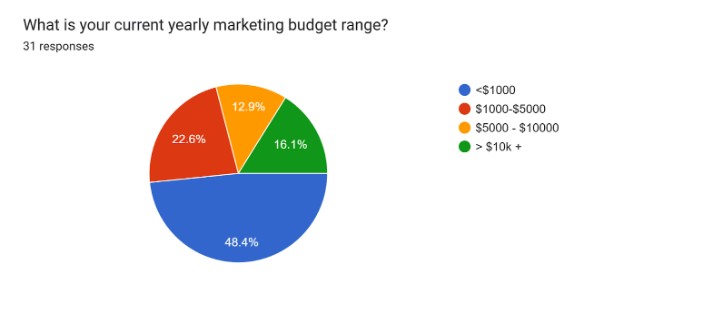
The survey shows that nearly 50% of businesses spend under $1000 per year on marketing.
Only 16.1% spend above $10,000.
Tip -> These methods prove effective when brand and trust of the business are established. However it limits the business to a client reach that goes only as far as repeat business (from existing clients) and growth relies on word of mouth. These methods reach mostly their business network. More active marketing is needed to reach beyond that.
Some business owners from this survey also shared their view that Google advertising has become less effective in the last 5 years and more money is needed to reach top ranking. To be included in AI search is also a challenge. Treating your Brand exposure like an ecosystem where customers can find you in several (ideally also reputable) streams is an advantage. AI looks for quality exposure and connectivity.
These findings need to be taken in context of two factors:
most respondents run a one person business
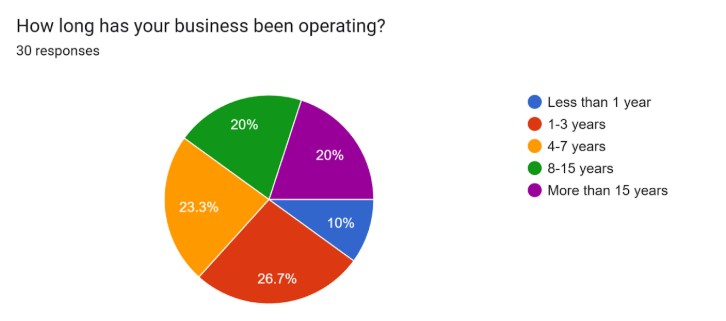
the age of the businesses that participated:
This explains why:
word-of-mouth dominates
most rely on organic social media
many don't track metrics
business owners feel overwhelmed
Low spend + low system adoption creates inefficiencies that professional support could address.
10. Top Current Priorities: More Leads & More Visibility
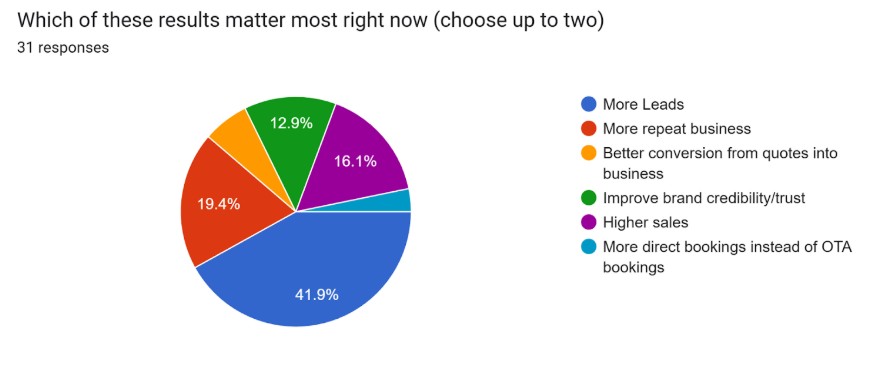
When choosing what matters most right now:
41.9% want more leads
19.4% want more repeat business
16.1% want higher sales
When asked what they’d fix with a magic wand:
- Increased visibility
- Better content creation that doesn’t take so much time
- Fully trackable marketing
Need for increased visibility and reach: To be more visible locally, achieve a wider reach, and get more local customers.
Content and platform strategy: Respondents desire help with content creation, knowing what platforms work best locally or nationally, and understanding what marketing efforts actually work.
Strategic and technical improvements: implementing an outreach strategy for higher-end clients, consistently posting on social media, updating websites, and being able to fully track marketing efforts.
Budget and cost concerns: Respondents mentioned needing more money for ad spend and decreasing the costs of SEO.
Brand and audience balance: finding the right brand balance to attract a wider net of audiences (i.e. multiple niches)
These priorities align with regional challenges: seasonality, competition, and a growing but strained population base.
Final thoughts
Running a small service business in Central Otago is not for the faint-hearted. The challenges we face as small business owners are many:
A fast growing region that is also seasonal, yet reputation-driven. More clients are needed, time is limited, marketing budget is limited, and many are unsure what actually works.
This survey makes one thing clear: you are not alone.
Across our region, business owners want the same things: more visibility, more leads, and more consistency year-round. But most are stuck relying on word-of-mouth, posting on social media when they have the time, or experimenting with advertising without a clear plan. And while referrals are powerful, they don’t reach beyond your existing network.
And while the day to day running of a service business takes specific skill sets, doing marketing on top, can be daunting. Unfortunately marketing (whether it is in the form of a reputable brand or actively launching campaigns) is the lifeline of a business. When done well, it builds trust, fills your calendar, and when done poorly (or inconsistently) it keeps you invisible.
Experimenting with marketing has been part of everyone’s marketing journey and that’s the key. There is no one size fits all. Knowing what works for your business is instrumental to your business success. This is the attitude needed to figure out what works best in marketing, especially with the era of AI automation looming round the corner.
Next Steps for Local Business Owners
The survey shows that word of mouth ranked on top to generate customers, expensive google Ads and website optimization was second, and social media campaigns third. There are strategies to maximise their effectiveness and conversion rates:
Word of mouth: ask for consistent reviews and set up a referral campaign. Email marketing is also a good tool to nurture and remind customers about your brand. Even if it doesn’t get opened all the time, it still reminds them of your business!
Google ads, another favourite among business owners. Experimenting with key words, phrases, SEO optimization of the website and creating other content like articles, and podcasts can improve searchability and AI search inclusion. I would also add: check your brand messaging on your website. Does it speak to the customer's pain points? Does it encourage the customers to take action? Is it clear? Is it short and concise?
Social media campaigns can easily be done with Facebook (advantage+ automation) however when done properly (with analysis, clear intent and low friction for the leads: low commitment) it’s more effective and saves you money in the long run.
I am going to do a deep dive into the highlighted issues small business owners find with marketing, with take away tips and tools. I invite you to join my newsletter and find out how to tackle each one of these marketing strategies:
✔ Finding customers beyond your referral network
✔ Showing your brand to thousands of the right prospects
✔ Building simple systems that save you time
✔ Clarifying your message so people choose you faster
✔ Turning your digital presence into a lead-generating asset
If you want clarity, visibility, and a reliable flow of customers next year, now is the time to put a plan in place, before the busy season takes over.
Every small business in Central Otago deserves a fair chance to be seen, trusted, and chosen. Not just the ones with the biggest budgets.
A BIG THANKS to all the Businesses that Participated and shared their knowledge and insights


Subscribe to our Mailing List
And that's just a peek at what we offer. Get more marketing tips straight to your inbox.